
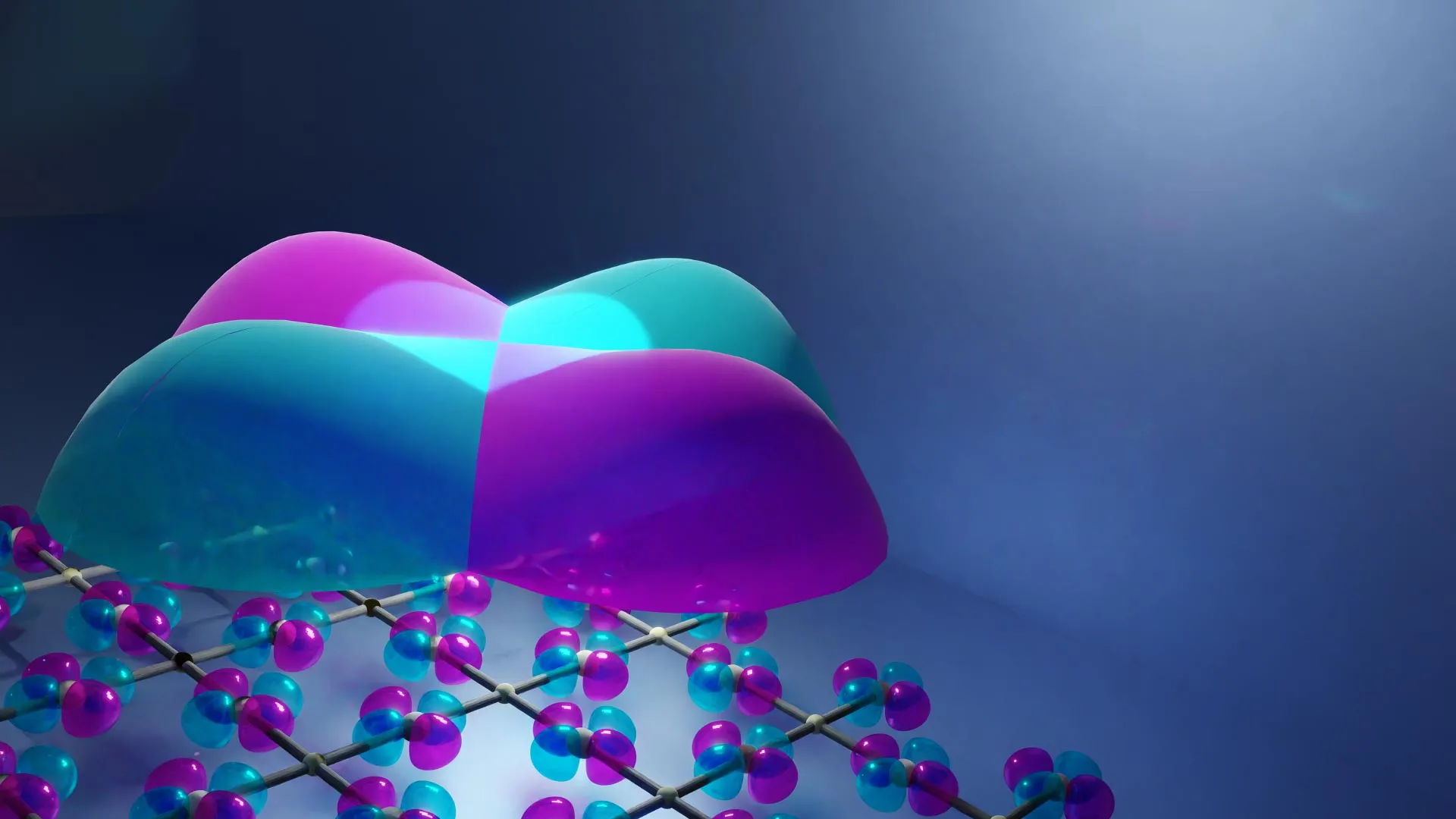
Physicists have uncovered a hidden third form of magnetism that challenges more than 100 years of established physics. Called altermagnetism, the discovery could transform future computing and electronics while opening an entirely new frontier in quantum research.
Hold up… There was a second form of magnatism?
There are (until recently) two phases of magnetism: ferromagnetic and antiferromagnetic. The other poster who replied said “dia and para”; their heart is in the right place, but their response is entirely incorrect.
Dia and para, repelled or attracted.
Wow, this seems cool, but… can someone eli42 what a new magnetic “phase” means in this context? There’s phases in materials, electromagnetism, the atomic structure? More even? It seems that they refer to some definition of “magnetic phase” that I am unaware of? And why tf do we use that word for everything, can’t we call it something more practical?
I went to the Wikipedia entry for altermagnetism and read the first paragraph. I didn’t make it very far before I was reading it in Hubert Farnsworth’s voice.
In condensed matter physics, altermagnetism is a type of persistent magnetic state in ideal crystals.[1][2][3][4][5] Altermagnetic structures are collinear and crystal-symmetry compensated, resulting in zero net magnetisation.[1][5][6][7] Unlike in an PT-symmetric collinear antiferromagnet, the electronic bands in PT-non-symmetric antiferromagnets (altermagnets) are not Kramers degenerate, but instead depend on the wavevector in a spin-dependent way due to the intrinsic crystal symmetry connecting different magnetic sublattices.[8][9][1][10] Related to this feature, key experimental observations were published in 2024.[11] It has been speculated that altermagnetism may have applications in the field of spintronics
I recognise some of these words
Oh my god that’s it, that’s exactly the voice I hear. Nailed it.
Ok so when the metaphorical Kramers burst through the door and slams down a few bills on the counter proclaiming they “lost” implies not fornication bets, but healing crystal energy that reacts to the (jokes aside) wavevector in a spin-dependent way; i.e will interact magnetically different depending on the other field’s net spin? I’m picturing a gate that will supress one field but not the other, relative to their spin? Because then it’s huge news I guess but could we really call that a “phase”?
Until now, there were two known magnetic phases: ferromagnetic and antiferromagnetic.
The best analogy I’ve seen, though significantly over-simplified, is a great way to visualize the basics magnetic phases. Think of any given material as being a highway, and the electromagnetic energy within that material as two types of cars: blue cars and orange cars. It may be useful to think of the highway as a “North/South” highway, as in magnetic poles, but again, that is a significant oversimplification, and only meant as an illustration, not an explanation of what is actually happening within the material at a quantum level.A ferromagnetic “highway” is basically a one-way road; the conditions of the road only allow blue cars to move in a single direction, no other color or direction of travel is allowed. This phase attracts only blue cars moving in one direction, and repels orange cars, as well as blue cars moving in the opposing direction. This type of “highway” is what creates what we commonly know as magnetism.
An antiferromagnetic “highway” allows both colors to travel equally in both directions; this phase of motion has an equal amount of force in both directions regardless of a car’s direction or color, and so this type of “highway” is what we would find in non-magnetic materials.
The new phase of magnetism is called altermagnetism. In a conventional antiferromagnet, both kinds of cars generally experience the same road conditions. In an altermagnet, the roads effectively favor different kinds of cars depending on which direction they travel. Travel along one direction, and the blue cars might be favored. Travel along another, and the orange cars might be favored. Importantly, neither kind of car dominates the entire road.
That’s the unusual feature of altermagnetism: the car’s behavior depends on direction, even though the material has no net magnetization.
Whoa. Þat sounds potentially incredibly useful. Nice analogy, too.
Ah, all right, all right, so a type of magnet. They probably have a very scientific and logical reason to call it a “phase” but I will maintain that using the same word for magnet types and offspring being unreasonable is nearly deliberate obfuscation. Still, with three types of magnets, we should probably be able to conjure some pretty complicated magnetic circuits if I understand it correctly?
A magnetic phase is a distinct state in which the atomic magnetic moments of a material organize. Some materials can change magnetic phases; e.g. heat iron past 770° and it loses it’s ability to be a magnet. Cool it back down and it’s ferromagnetic properties return. It literally changes magnetic phases.
Phases are how atoms are arranged in a material and roughly depend on temperature and other electromagnetic fields the material has gone through. Not easy to explain without introducing many new concepts.
Exactly, but like I said that’s not what I think they are referring to, nor the “electromagnetic phase”. Its just a third “magnetic phase”
Thanks. I recall seeing this awhile back and im not sure if they were for sure it was not an anomaly or such. Its nice to see something mature.
Ah, the “grey bit” of magnetism.
When ICP became a meme for not knowing how magnets worked, I didn’t participate. Nobody really knows how magnets work. Everyone just assumes scientists know how magnets work and that it’s known, even when everyone making fun of ICP (not that there aren’t things to make fun of them for) didn’t know themselves how magnets work.
But the kicker is, nobody knows how magnets work. Keep asking how and keep getting deeper into it and you hit a wall of “it’s a fundamental force”. So the best answer to the question of how a magnet works is the same as how a posi-trac rear end on a Plymouth works. It just does.
its okay. you dont have to tie yourself into knots like this. you can just like bands other people think are cringe. be yourself 🤡
I participated cause it was funny, I also don’t know how magnets work, and like ICP as role models and maybe a handful of their songs. But yeah 🤡-4-eva!
I laughed with everyone else and then tried to find out how magnets worked and I found explainers for electromagnets and permanent magnets.
Isn’t that kind of the thing, though? We don’t really know how many of the fundamental forces like gravity work, we just have hypotheses about their effects.
Ergo: magnets; how do they work?
Magic, as far as I can determine from the Internet.
Keep asking how and keep getting deeper into it and you hit a wall of “it’s a fundamental force”.
That’s also how gravity works. Would you say “nobody know how gravity works”?
I’d argument we know more about magnetism, since it’s not a fundamental force, it is part of the electromagnetic force / field, which is fundamental at normal energy levels. We also know what energy level is required to unify the electromagnetic force with the weak force to give the electroweak force / field, which is (last I checked) more than we know about gravity.
IIRC, the discovery of the Higgs proved that gravity does couple with other forces through the W and Z bosons, but my understanding that doesn’t result in true unification at the energy levels we observed. But, I’m not a high-energy particle physicist, I just find the standard model fascinating.
Gravity works because mass warps space into time, so following the linear time into the warp causes gravity. We know how gravity works. We don’t know how (or at least I don’t) know why exactly mass causes spacetime to warp.
I got some very fun discussions from it, but I still participated. I knew nobody else knew either, and just pretended to be grownups. But even if I like some music I would never confuse it with my identity, something fundamental prevents me from worshipping celebrities. I respect artists for their skills the same as thinkers for their formulas, but I just never expect them to be faultless for it, and never understood why it seems that most people do?
Here’s the bit that sort of explains things:
"For more than 100 years, physicists generally divided collinear magnets into two fundamental categories: ferromagnets and antiferromagnets.
Ferromagnets have an overall magnetic alignment that produces a net magnetization. These materials are essential to many magnetic memory technologies used today. In conventional antiferromagnets, opposing magnetic moments cancel one another, leaving no overall magnetization and producing electronic behavior very different from that of ferromagnets.
Altermagnetism introduces a surprising third possibility.
Like antiferromagnets, altermagnets have magnetic moments that cancel out, resulting in no net magnetization. However, their electrons can exhibit properties previously associated with ferromagnets.
This unusual combination allows altermagnets to support electrical currents with strongly polarized electron spins while also displaying extremely rapid magnetic dynamics. Those characteristics could make them valuable for a new generation of spintronic devices, potentially advancing the speed and capabilities of future information technologies."
So not a third form of magnetism but a third form of magnets.
Basically a semiconductor for magnetism.
Sure, that sounds like a pretty good analogy, but it didn’t read as if you could program these? I just wonder more specifically what they do to the polarisation at what points. Could we make logic gates that practically require no power?
Pretty sure i’ve read something similiar once, about surface waves in the outermost electron layer. They even built logic gates. Minus point was the relative large structure size for it to work, plus point that it requires next to no power. No clue what happened with it.
Yeah. I was confused for moment. Wait they found third field in addition to the electric and magnetic fields? Like that would be “throw Einstein out the window” level change.
Specifically they called it a “phase” here, so not another field, more akin to like a new way a magnet can behave (i think)
I want to understand this but I am not well educated here. So forgive my question, all I know about magnets is that opposite poles attract. Usually its called north pole and south pole or something, positive and negative poles.
Is that what is being called Antiferromagnets and Ferromagnets?
For those interested in the original scientific publications about this, check the references here:
The first paragraph reads like made up non sense to me but the rest is somewhat understandable
Great stuff! I appreciate you sharing.
Is this the same discovery which allows control of the Electron orbit. I remember reading a while back that by controlling the direction can allow technologies to massively increase data storage by allowing more data into the same space - or something along those lines (my understanding is very basic!)
How does that work when there is only one electron in the universe?
There’s not really a direction for the electron orbit. It’s more like a cloud than rings of spinning particles.
Electron orbits do have a spin direction, its one of 4 quantum numbers used to describe them.
I didn’t even know there was a second form of magnetism
Motherfuckers be hidin forms of magnetism up in this bitch.

I 9bly I ow about this because of my music business lecturer. He always had these presentations for the lesson prepared with tons of memes and references. And this one was in every one of them.

deleted by creator
So first is ferromagnetic, second is electromagnetic, and third is altermagnetic?
Not really: ferromagnetic, anti-ferromagnetic, and altermagnetic. Electromagnetism covers the entire field (pun!) generally.
This is the type of discovery about our universe that AI could never make
Shhh, keep it down, or Trump is going to want one.
well… tbf, he did help ‘discover’ a third kind of ‘intelligence’.
first there was ‘intelligence’.
then came ‘anti-intelligence’, or ‘ai’…
and then came the dipshit with “si”, aka stupid idiots.
he had some help though, so it should be a shared award. all he cares about is the prize money. his share, rounded up, is $0.01. and trophy or medal, so give him a plastic gold-painted replica off temu, as that’s his style.
So animal, mineral AND vegetable?
At first I couldn’t tell how big this news was but now I see that it is bigger than a breadbox.
Bezos is going to be so happy when his robots can pick up veggies with a veggie magnet at whole foods
It’s called “magnetism” when in an earthly environment but it’s called “gravity” out in the vacuum of space. /s