

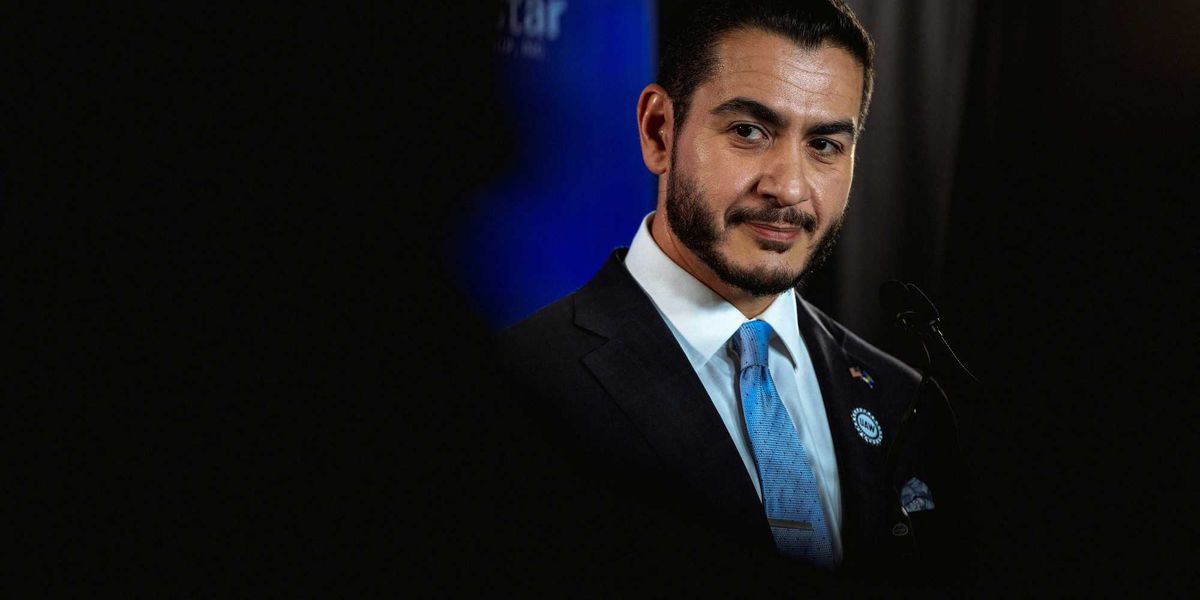
The attendee who pressed Democratic Senate nominee Abdul El-Sayed to disavow the Muslim Brotherhood at a tense town hall this weekend was exposed as a former GOP staffer with “Christian nationalist ties,” journalist Marisa Kabas reported.
As first reported by Kabas on her Substack The Handbasket, Tommy was actually Thomas Teepell, who previously served as operations director for Sen. Josh Hawley (R-MO) until February of this year.
Teepell’s father is Timmy Teepell, a GOP strategist who worked for former Louisiana Gov. Bobby Jindal through his climb from congressman to governor. Jindal is the founder of America Next, a conservative PAC that, according to The Michigan Daily, offered Republican college students $200 to travel to an El-Sayed event to “heckle” the Democratic candidate and ask provocative questions.
(…ctd)
Once the government acquires the power to define the nation’s officially favored faith, what limits that power?
Madison explicitly warned that a power capable of establishing Christianity could also establish one Christian sect over another. The danger is institutional, not merely theological: the machinery of religious privilege can be inherited by whoever next controls the state.
Act V: The uncomfortable historical complication It would be historically dishonest to portray every founder as a modern secular pluralist. Several states retained religious establishments or religious qualifications into the early republic. Many founders used providential language, believed religion encouraged virtue, and held views of religious equality that fell far short of modern standards. The republic they created also excluded many people from full political participation.
There is a second distinction worth preserving: a religiously influenced republic is not the same thing as a republic constitutionally subordinated to religion.
The federal Constitution prohibits religious tests for federal office in Article VI. The First Amendment prohibits Congress from establishing a religion and protects its free exercise. These provisions do not require citizens to keep religious convictions out of politics. They constrain the government’s authority over religious belief and practice.
The 1797 Treaty of Tripoli offers additional evidence. Its famous declaration that the American government was not founded on the Christian religion was part of a diplomatic agreement, and historians debate how broadly to interpret it. It should not be treated as proof that every founder was secular.
That nuance actually strengthens the central argument. You do not need to claim that the founders were atheists, that Christianity had no influence, or that they anticipated every modern conception of equality.
You need only distinguish between their religious beliefs and the constitutional powers they authorized. The final verdict If we asked the founders to vote on Christian nationalism as a single, clearly defined political doctrine, we would be imposing a modern label on a divided historical group. Their answers would depend on what the doctrine demanded.
It is whether a political community can claim to defend freedom while reserving the authority to decide which citizens possess the correct ultimate beliefs.
The strongest Madisonian answer would be that a government established to protect liberty cannot make the liberty of conscience conditional on agreeing with the majority’s theology.
And the most ironic possibility is that a movement claiming to restore the founders’ legacy could undermine one of their most important institutional achievements: a constitutional government whose legitimacy does not depend on establishing a single religious orthodoxy.
That is the argument worth having, rather than the historically weaker shouting match over whether the founders were all Christians or all secularists.
source I asked GPT “express to me how the founding fathers of the usa might debate the concept of a Christian Nationalist?”
Ps. I really do not enjoy using LLM’s but if they could be used to take down the heritage foundation, then meh
shrugs
AI;DR
I appreciate your comment, because it points out that what I thought was unhinged fan fiction that I should skip is actually unhinged fan fiction written by a word-prediction machine, and therefore even less deserving of my time and attention.
Removed by mod
Actually it helped others to not read your slop.
How does it feel to outsource your thinking to a statistical parrot that destroys the environment?
Do better.