

1·
2 days agoThanks! I’d probably do then all except the last one – not worth it imo
Thanks! I’d probably do then all except the last one – not worth it imo
Where do you check?

If you already have nextcloud, it has a decks feature

Crazy song, wow
How to find out if 9front is right for you?

You can also leave without a key and then your roommate also leaves and locks the door.
What is your policy on AI?

Can you look harder for remotes without mics?
I’ve gotten used remotes at goodwill before
Who is channel 5

We have this in the US too, with conservatives the most wrong about crime statistics vs reality.
Fox news is really good at plucking anecdotes and promoting them broadly.
Britons consistently overestimate how dangerous the county really is
Read the research
Wrongful convictions - misperceptions of crime (4.9MB pdf)
Most crime in England and Wales is falling – but the public think it’s rising. In fact, they are wrong about crime on nearly every measure: from how many people fall victim, to the ethnicity and nationality of offenders, and whether police numbers have increased or decreased, according to a major new study from the Policy Institute at King’s College London.
Based on two surveys of 1,797 and 2,164 UK adults, carried out with YouGov between 23 and 27 March 2026, Wrongful convictions? Misperceptions about crime among the UK public finds that while mistaken beliefs about crime are not confined to one political party, Reform UK supporters stand out as consistently most wrong – particularly on the ethnicity of those convicted of serious offences and the share of prisoners and offenders who are foreign nationals.
The study – part of a new research series called Mistaken Britain – also shows why these incorrect beliefs matter, with those who hold misperceptions about crime more likely to feel there is “two-tier justice” in the UK, more sceptical of the government’s ability to deal with crime, and more supportive of harsher, more punitive crime policies.
What the public get most wrong about crime
- The public overestimate how many people are victims of crime. Asked what share of the population in England and Wales personally experienced crime between 2024 and 2025, the public’s median guess is 27% – almost three times the reality of 9.7%.
- Crime is falling, but the public think it’s rising. Of five crime types tested, only shoplifting has actually risen since 2010 (up around 70%) – and the public gets that one right (84% say it increased). On every other measure, perception and reality point in opposite directions: 83% think mobile phone theft has risen when it has fallen by around 70%; majorities think domestic burglary (56%) and vehicle theft (62%) have risen when both have fallen by around 50%; and 37% think murder has risen when it is down around 20%.
- The public wrongly assume most people convicted of homicide are from an ethnic minority. In fact, 64% are white – but the public’s median guess is just 45%. Conversely, they overestimate the ethnic-minority share, putting it at 55% when the reality is 35%.
- Foreign nationals are assumed to be roughly double their true share of offenders. The public’s median guess is that foreign nationals make up 25% of the prison population (reality: 12%) and 30% of those cautioned for or convicted of sexual offences (reality: 15%) – around double the true proportion in both cases.
- The public wrongly think police numbers have been cut. Police officer numbers rose around 20% between 2018 and 2025, but two-thirds (63%) think they fell, and only 18% correctly say they rose at all.
- People think others are more fearful than they actually are. The public guess 60% of the population do not feel safe walking alone in their area after dark – significantly higher than the reality of 39%.
- Recency shapes the public’s perception of terrorism deaths. The 2000s and 2010s had the fewest terrorist deaths of any decade in the last 50 years – yet the public rank them second and third most deadly respectively. 27% correctly identify the 1970s as the deadliest – the top single option selected – but 55% wrongly pick a more recent decade.
Reform UK supporters stand out as most mistaken
Misperceptions about crime are not confined to one party, but there is a consistent gradient, with Reform supporters the clearest outliers.
- Reform UK supporters most underestimate the share of people convicted of homicide who are white (guess: 30%; reality: 64%), and most overestimate the share who are from ethnic minorities (guess: 70%; reality: 35%) – in both cases, wide of the mark by 10 points more than any other party.
- They most overestimate the share of those cautioned for or convicted of sexual offences who are foreign nationals, guessing it’s 50% – far above Conservatives (30%), who have the second-highest guess, and more than three times the reality of 15%.
- They have an inflated view of the risk of being a crime victim in England and Wales, guessing 34% were victims in a single year, against 25% among Conservatives and 20% among Labour, Lib Dem and Green supporters – all far above the 9.7% reality.
- Reform supporters guess 75% of the public do not feel safe walking alone in their area after dark –15 points higher than Conservatives (60%), who have the second-highest guess, and almost double the reality of 39%.
- On police numbers in England and Wales, majorities of all parties’ supporters wrongly think they fell, but 74% of Reform supporters have this misperception, compared with 66% of Conservative and 63% of Labour supporters.
How misperceptions link to attitudes and policy preferences
Misperceptions track how fearful people feel, how much they trust institutions, and what they want done about crime.
- Misperceptions are related to perceptions of “two-tier justice”. A majority (52%) of the public think ethnic or religious minorities are sentenced differently for crimes, with slightly more saying they are treated more leniently (29%) than harshly (23%). However, this belief is significantly higher among the factually mistaken: among those who wrongly think minorities make up 80%+ of homicide convictions, 44% say minorities get lighter sentences, compared with 29% of the public overall.
- Misperceptions connect to fear and distrust. Among those who say their quality of life is highly affected by fear of crime, 59% wrongly think murder has risen in England and Wales, versus 22% among those who say fear of crime has little impact on them. And while 35% of the public overall say they have no confidence at all in the government to deal with crime nationally, this rises to 46% among those who wrongly believe police numbers have fallen by a fifth or greater, and to 48% among those who incorrectly think murder has risen.
- There is a national vs local perception gap on crime. 65% expect crime to rise across the country as a whole over the next three years, yet only 40% expect it to rise in their own area.
- Mistaken beliefs are linked to more punitive policy demands. Support for harsher sentences for immigrants rises to a majority (54%) among those who wrongly think foreign nationals make up half or more of the prison population – above the 35% of the public overall who back such a policy.
Professor Bobby Duffy, Director of the Policy Institute at King’s College London, said:
“The public are very wrong about crime – they think the risk is higher than it is, that everything is getting worse when many aspects are improving, and that police numbers have fallen when they’ve actually risen. There’s no single reason for this mistaken view of a key aspect of life in Britain: it’s an interaction between how we think and what we’re told.
“We have a deep negativity bias that tunes us to threat, and a rosy view of the past that makes us assume things were safer in the past than they were. When people respond with an inflated measure of crime, they aren’t just trying to estimate a reality – they’re sending a message about what worries them. And that’s compounded by what we’re told: ‘If it bleeds, it leads’ is a key news value for a reason, so the picture we’re fed points relentlessly to the frightening and the violent.
“But these misperceptions also vary significantly across the public – they are far larger among Reform UK supporters, and they hit hardest where crime connects to other concerns like immigration and diversity. For example, Reform supporters think ethnic minorities make up 70% of those convicted of homicide, which is double the reality.
“The hard truth is there are no easy fixes – this is rooted in our psychology and in real media, social media and political incentives to play to our concerns. Simplistic myth-busting won’t do it on its own, because it misdiagnoses a large part of the cause: these beliefs are as much about identity and emotion as information. But that’s not a reason to give up on the facts – it really matters for individual quality of life and the quality of debate in a country that these misperceptions are recognised, and we do a better job of communicating the reality.”
++Study details ++
All figures, unless otherwise stated, are from YouGov Plc. Total sample size was 1,797 adults for all questions, except for the question on the share of the public who personally experienced a crime between 2024 and 2025, where the sample comprised 2,164 adults. Fieldwork was undertaken between 23 and 27 March 2026. The survey was carried out online. The figures have been weighted and are representative of all UK adults (aged 18+) by age, gender and education (interlocked), vote in the 2024 general election and region (interlocked), vote in the 2016 EU referendum, socio-economic classification, political attention, and ethnicity.The question on the ethnicity of those convicted of homicide was asked as a split sample experiment, to test whether telling respondents what share of the overall population each ethnic group represents improves the accuracy of their guesses. Median guesses on this question are derived by combining results across both halves of the sample.
++Sources for “realities” ++
Most crime reality figures in the report are for England and Wales rather than the whole UK, reflecting that crime, policing and justice are devolved, and the official data is reported on that basis – though the figures are broadly consistent whether measured for England and Wales or the UK as a whole. The exception is terrorism, where the underlying data covers the whole UK. See full report for sources.In this story
Professor Bobby Duffy
Director
I was trained as a chemist (but i don’t practice professionally). I have never heard this claim either.
Seems like a weird law to me too.
I don’t usually like the government involved in things like this.
Sinema described their sexual encounters during a deposition in July, testifying the relationship became sexual in 2024 during a trip to Napa
Friday 04 September 2026 22:31 BST
Bookmark popover
Removed from bookmarks
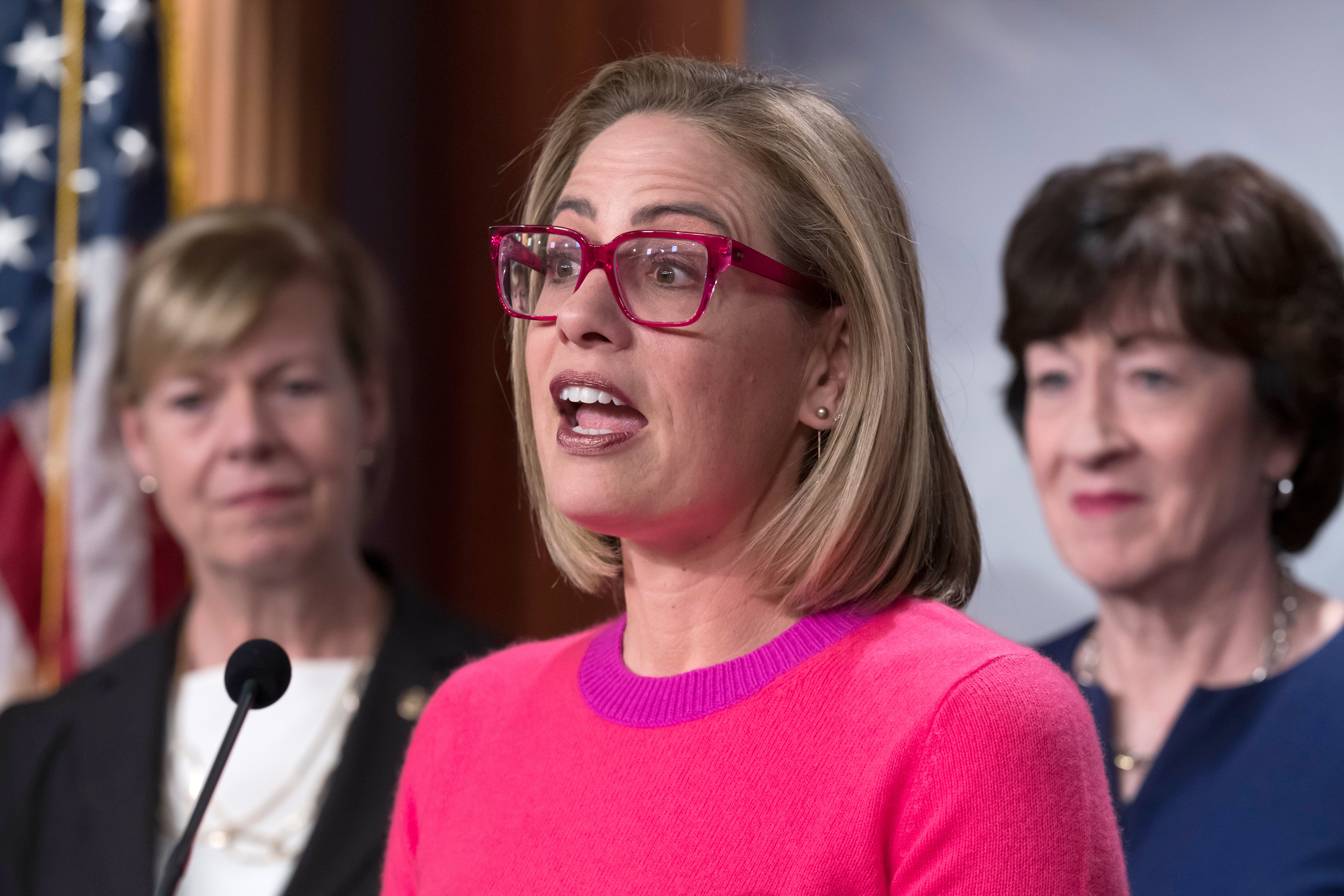
The bodyguard’s wife claimed she and her husband had a ‘good marriage’ until the lawmaker intervened (Getty Images)
A judge has cleared the way for former U.S. Sen. Kyrsten Sinema to be sued under North Carolina’s homewrecker law.
Sinema tried to argue she shouldn’t face a lawsuit over her relationship with a member of her security detail in North Carolina because she has no connection to the state.
U.S. District Judge David A. Bragdon rejected that claim and ruled that nine text messages sent to Matthew Ammel, her bodyguard, while he was in the state establish North Carolina’s jurisdiction over her. He called it implausible that she was unaware of Ammel’s whereabouts when texting him.
Steven Epstein, Sinema’s attorney, did not immediately respond to an email seeking comment.
Sinema has acknowledged having a romantic relationship with Matthew Ammel but argued that she can’t be sued in North Carolina because she has no connection to the state (AP Photo/J. Scott Applewhite)
The legal action, brought by Ammel’s ex-wife, seeks financial compensation from Sinema, who represented Arizona in the U.S. House and later completed a single term in the Senate early last year.
North Carolina is among a small number of states allowing jilted spouses to bring suits for “alienation of affection” to obtain damages from a third party deemed responsible for a broken marriage.
Matthew and Heather Ammel maintained “a good and loving marriage” with “genuine love and affection” prior to Sinema’s interference, pursuing Matthew Ammel despite knowing he was married, Heather Ammel alleges in her lawsuit.
Matthew Ammel joined Sinema’s security team after retiring from the Army in 2022 and accompanied her on domestic and foreign travel, the complaint states.
In early 2024, Heather Ammel discovered “romantic and lascivious” messages exchanged between her husband and Sinema on the Signal messaging app. By that summer, he stopped wearing his wedding ring, and Sinema appointed him as a national security fellow in her Senate office as he continued working as a campaign bodyguard, the lawsuit states.
During a deposition in July, Sinema described their sexual encounters, testifying the relationship became sexual on May 27, 2024, during a trip to Napa, California. She stated they later had encounters in New York, Washington, Colorado and Arizona, but never North Carolina.
Matthew and Heather Ammel separated on Nov. 1, 2024.

The second screen is phoning home
This page reminds me how they couldn’t handle being on Mastodon, and closed their account, but they have no problem with staying on Twitter.
And they say they’re not political.
Thanks!
What is typst




This is standard on all phones and macs. Glad that speech to text is now available on Linux. Wish they didn’t call it AI…